One must move strategically with utmost caution and take steps keeping in mind whether an offense is a bailable offense or a non-bailable offense.
Getting bail can be a tedious task when it comes to offenses such as Forgery, Murder, Rape, Dowry Death, kidnapping, criminal breach of trust, causing grievous hurt, attempt to murder, or half murder.
In case you apprehend an arrest for the cases cited above, immediately contact a good criminal lawyer, and apply for anticipatory bail. In cases where anticipatory bail can’t be granted, ask your criminal lawyer to seek interim protection. This shall help you seek bail in the future.
Types of Bail
1. Anticipatory Bail
An Anticipatory bail is filed u/s 438 of CrPC. It is commonly known as pre-arrest bail. A person who is apprehending arrest can file and seek the same from the Court of law.
2. Regular Bail
A regular bail is applied before the Sessions Court or the High Court. One can apply for a regular bail only after the arrest is made.
Rights of an Arrested Person in Case of a Criminal Case
1. The Right to remain silent.
2. The Right not to be detained for more than 24 hours without judicial scrutiny.
3. The Right to know/ask about the grounds of arrest.
4. The Right to get bail.
5. The Right to consult a legal practitioner.
6. The Right to be examined by a doctor.
7. The Right to inform a relative/friend.
8. The freedom to communicate with the magistrate.
9. The Right of the accused to produce the Evidence.
The above rights of an arrested person are ensured and protected by law and no one shall take away your rights from you. Right number 5 (The right to consult a legal practitioner) is of vital importance as it will create the basis of your case.
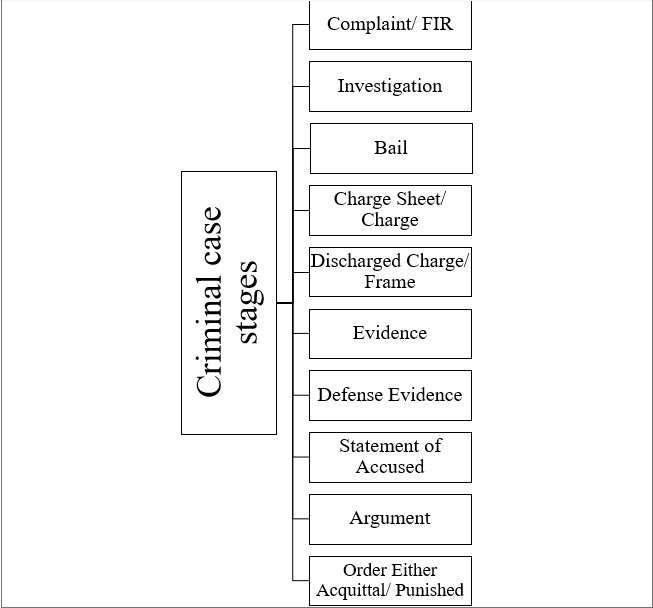
Important Stages of a Criminal Case
Offenses and Punishments under the Indian Penal Code
1. Capital Punishment
Punishment of Death is commonly known as capital punishment. There are various offenses under the IPC which provide ‘death’ as the maximum punishment. A few offenses are listed below:
- Section 121 IPC; Waging or attempting to wage war against the Government of India
- Section 302, IPC; Punishment for Murder
- Section 305, IPC; Abetment of suicide of child or insane person
- Section 364A, IPC; kidnapping for ransom
- Section 396, IPC; Dacoity with Murder
2. Imprisonment for Life
Imprisonment for life is a punishment wherein an accused convicted of a crime has to remain in prison as long as he is alive or until pardoned. In its natural sense, it means imprisonment for the remaining years of life.
3. Imprisonment
Imprisonment can be simple imprisonment or rigorous imprisonment. Depending upon the severity of the offense, the Court issues such imprisonment.
-
Rigorous imprisonment;
- Section 194, IPC; Giving or fabricating false evidence with intent to procure conviction of capital punishment
- Section 449, IPC; House-trespass in order to commit offense punishable by death
4. Forfeiture of Property
- Section 126, IPC
- Section 127, IPC
5. Fine
Imposition of fine for the wrongs committed under various sections of the IPC.
How Our Law Firm Can Help: Expertise in NRI Legal Criminal Matters
Our law firm focuses on handling criminal issues faced by NRIs. We have a deep understanding of the unique challenges involved and are equipped to provide effective legal solutions. Our team is well-versed in both Indian and international legal systems, ensuring comprehensive representation for our clients.
Property Disputes
We assist NRIs in resolving property disputes by conducting thorough investigations, gathering evidence, and representing clients in court. Our services include filing criminal complaints for trespass, forgery, and fraud, as well as civil suits for property recovery.
Cyber Crime Defense
Our advocates help NRIs navigate the complexities of digital offenses. We work closely with cybersecurity professionals to gather digital evidence and build a strong defense. Additionally, we assist clients in filing complaints with the relevant authorities and pursuing legal action against perpetrators.
Matrimonial and Family Law Matters
We provide compassionate and effective legal support in matrimonial disputes. Our services include filing and defending against criminal complaints such as dowry harassment and domestic violence. We also handle issues related to child custody and maintenance, ensuring that our clients’ interests are protected.
Fraud and Cheating Cases
Our firm has extensive experience in handling fraud and cheating cases. We assist NRIs in filing criminal complaints, pursuing legal action against fraudsters, and recovering lost assets. Our team conducts thorough investigations to build a strong case and ensure justice is served.
Our team comprises seasoned legal professionals with expertise in criminal law and NRI legal matters. We have successfully represented numerous NRIs in complex criminal cases, securing favorable outcomes for our clients.
We understand that every case is unique, and we tailor our legal strategies to meet the specific needs of our clients. Our personalized approach ensures that our clients receive the best possible representation and support throughout the legal process.
From initial consultation to final resolution, we provide comprehensive legal support to our clients. Our services include legal advice, representation in court, and assistance with documentation and compliance.
Strong Network
We have a strong network of legal professionals, investigators, and experts across India and internationally. This enables us to provide effective legal representation and resolve issues promptly.
Navigating criminal issues and legal matters in India can be daunting for NRIs. Our law firm is dedicated to providing legal support to NRIs facing criminal charges or legal disputes. With our extensive experience and personalized approach, we ensure that our clients receive the best possible representation and achieve favorable outcomes. If you are an NRI facing legal issues in India, contact us today for a consultation and let us help you navigate the complexities of the Indian legal system.
The List of Facilities Provided by Thukral Law Associates
- Providing legal assistance in filing police complaints/registration of FIR/ criminal complaint: It is a vital part of a criminal case as it will decide the basis of your case further.
- Section 154 of Cr. P.C: It deals with filing a criminal complaint before the Police station.
- Providing representation in Anticipatory bail and regular bail u/s 438 and 437 of Cr. P.C.
- Assistance in filing/ defending in matters of section 138 of N.I.Act before a magistrate.
- Filing/ representing in petitions under section 482 of Cr. P.C.
- Presenting arguments under various sections/provisions of Criminal Complaints of the Indian Penal Code.
- Protecting clients from acts such as fraud and cheating in regard to the Companies Act.
- Presenting representation/ filing matters of Revision, Criminal Writ with regard to acquittal and conviction.
- Providing legal assistance in cases of Murder u/s 300 of The Indian Penal Code.
- Providing legal assistance in matters of Dowry Death u/s 304b of The Indian Penal Code.
FAQs
Can I defend myself in my criminal case?
Yes. You can defend yourself in your case but appointing an advocate will help you better dispose of your case.
Do I have the right to meet my lawyer if accused of a criminal case?
Yes. Meeting and consulting your lawyer is your right.
Is it mandatory for a person who is charged with a crime to give bodily samples?
Yes. You might think that being forced to give bodily samples—such as blood, hair, or fingernail clippings—is a violation but it’s mandatory.
Who can arrest me?
All Law enforcement officers such as police officers, county sheriff officers, district attorneys, and highway patrol officers can arrest you on or off duty in most cases.
Can I get Bail for a non-bailable offense?
Yes. A person arrested for a non-Bailable offense can also apply for Anticipatory bail u/s 438 of Cr. P.C.
Who maintains the arrest records?
Local and State Police departments keep the records.
When can I be released?
If the police officer is convinced after the questioning that you have not committed the crime.
Can someone other than a police officer arrest me?
Yes. If they give a valid reason for doing it.
Can I make a call to my friend/relative after being arrested?
Yes. That’s your fundamental Right.



.jpg)


 Mr. Karan S. Thukral
 Mr. H.S. Thukral
 Ms. Bani Thukral
 Ms. Preneet Kaur
 Ms. Vaishnavi Arora
 Mr. Tejvir Singh
 Mr. Nitin Bajaj
 Ms. Sanjivini Bora
 Ms. Neha Narayan
 Ms. Shriya Shrivastava
 Ms. Harpreet Makkad
 Ms. Jashanpreet Kaur
 Ms. Kritika Arora
 Mr. Sachin Arora
 Ms. Suruchi Singh